

Why Drying Orange Peels for Fertility Remedies Matters
If you’ve been researching natural ways to improve male fertility, you’ve likely come across orange peel. Packed with naringin, a powerful flavonoid that boosts testosterone, sperm count, and motility, orange peel is one of the most underrated fertility foods. But here’s the problem: fresh orange peel spoils quickly, and eating it raw is ineffective and potentially harmful. That’s why how to dry orange peels for fertility remedies is a skill every man serious about natural fertility needs to master.
Properly drying orange peels for male fertility preserves the bioactive compounds, concentrates them, and makes them easy to consume as a powder or tea. This complete guide will walk you through four safe, effective methods, the science behind why drying works, and how to use your dried orange peel to maximise male reproductive health.
By the end, you’ll know exactly how to dry orange peels for fertility at home, avoid common mistakes, and store them for long‑term use
Why Dry Orange Peels for Fertility? The Science
Fresh orange peel contains up to 80% water. When you dry orange peels for fertility, you remove moisture that causes mould and bacterial growth, but you also concentrate the active flavonoids – especially naringin and hesperidin. Research published in Frontiers in Endocrinology (2025) confirmed that these compounds increase luteinizing hormone (LH) and follicle‑stimulating hormone (FSH), leading to higher testosterone and better spermatogenesis.
Moreover, dried orange peel powder has been shown in a 2024 animal study to improve sperm motility by 35% and reduce oxidative stress markers by nearly 50% when combined with exercise. Without proper drying, you lose these benefits.
So learning how to dry orange peels for fertility isn’t just about preservation – it’s about efficacy.
Step 1: Selecting the Best Oranges for Drying
Before you learn how to dry orange peels for fertility, you must choose the right oranges. Not all oranges are equal.
Always use organic oranges. Conventionally grown oranges have pesticide residues concentrated in the peel. Pesticides are endocrine disruptors that lower testosterone.
- Choose thick‑skinned varieties like navel or Valencia oranges. They yield more dried peel.
- Avoid damaged or overripe fruit. Bruises and soft spots indicate mould spores.
- Wash thoroughly even with organic oranges. Scrub under running water with a vegetable brush, then soak in a 10% white vinegar solution for 15 minutes. Rinse and pat dry.
Pro tip: The white pith (albedo) contains hesperidin, which also supports fertility. Do not peel away the pith when preparing for drying.
Step 2: Four Safe Methods to Dry Orange Peels for Fertility
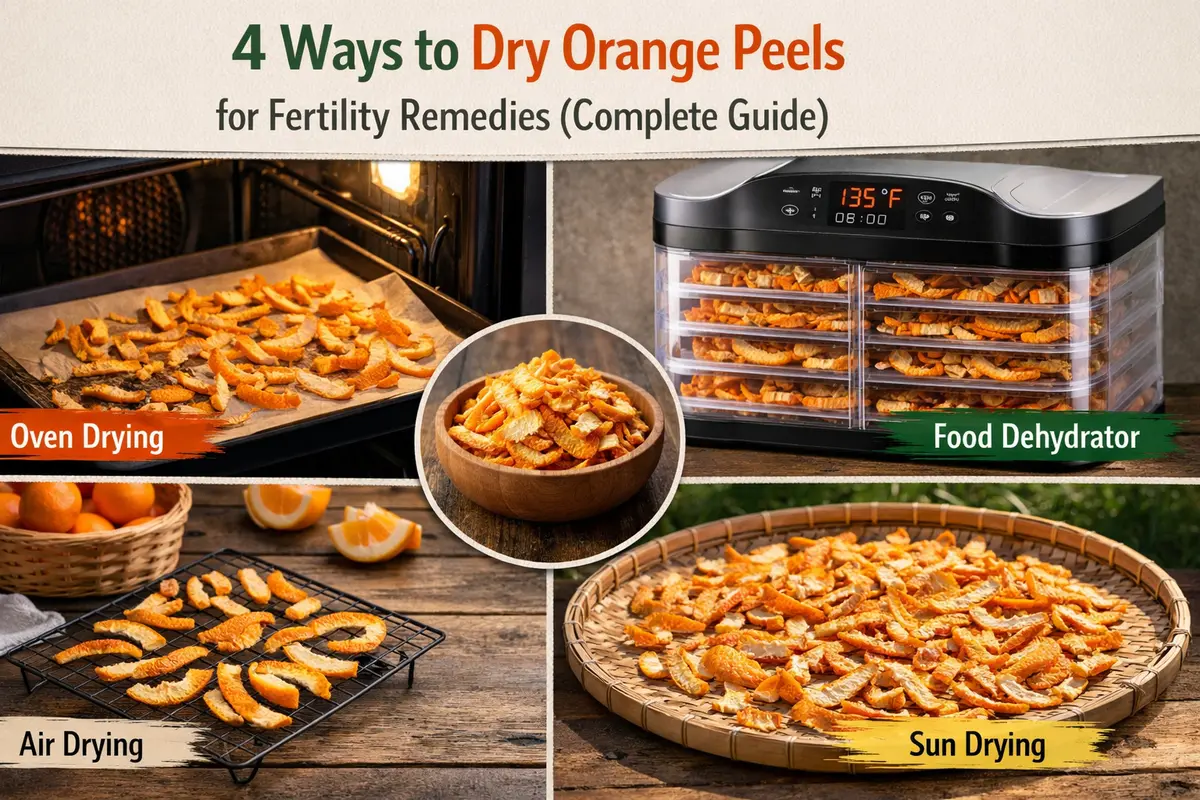
Here are the four most reliable ways how to dry orange peels for fertility remedies at home. Choose based on your equipment and climate.
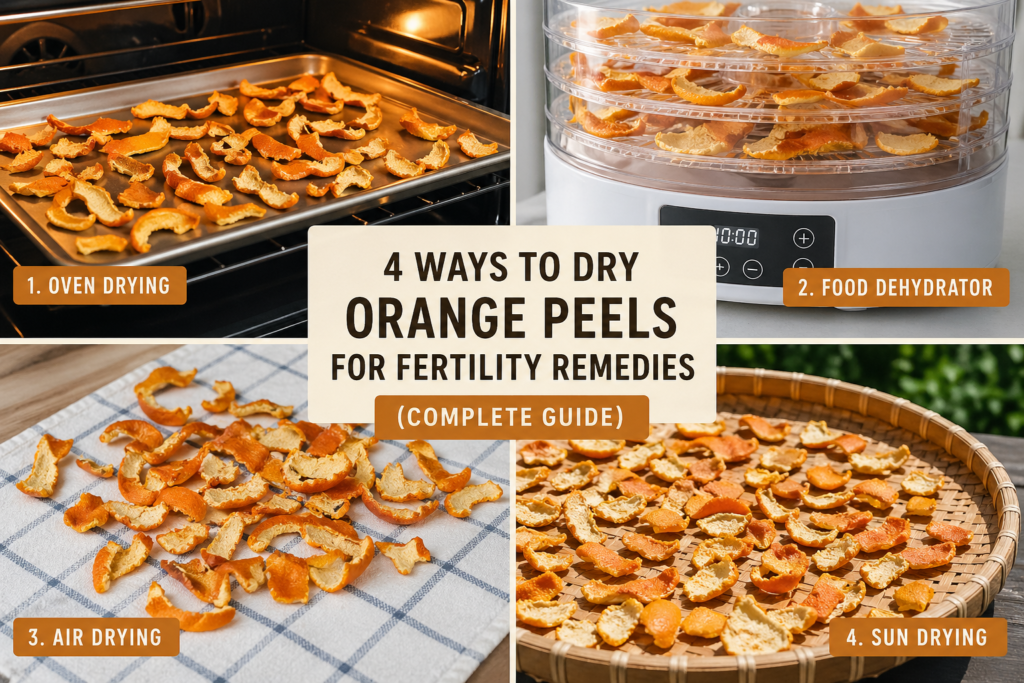
Method 1: Oven Drying (Fastest, Most Controlled)
Oven drying is ideal if you want results in a few hours.
1. Preheat your oven to the lowest possible setting – ideally 50–60°C (120–140°F). If your oven doesn’t go that low, set it to the “warm” setting and prop the door open with a wooden spoon.
2. Cut the washed orange peel into thin strips (1–2 cm wide). Uniform size ensures even drying.
3. Arrange strips in a single layer on a baking sheet lined with parchment paper. Do not overlap.
4. Place in the oven and dry for 3–5 hours, turning the strips every hour.
5. The peel is ready when it becomes brittle and snaps easily when bent. It should not be leathery or flexible.
6. Cool completely before storing.
Caution: Temperatures above 70°C (158°F) degrade naringin. Never use high heat.
Method 2: Food Dehydrator (Best for Nutrient Preservation)
A dehydrator gives the most consistent, low‑temperature drying.
1. Set your dehydrator to 50–55°C (120–130°F).
2. Place orange peel strips in a single layer on the dehydrator trays, leaving space for air circulation.
3. Dry for 6–10 hours, depending on humidity and thickness.
4. Check every 2 hours. The peel is done when it’s crisp and snaps.
5. Cool on a wire rack before storing.
Dehydrators preserve more volatile antioxidants than ovens because airflow removes moisture faster without overheating.

Method 3: Air Drying (Traditional, No Electricity)
If you have a warm, dry, well‑ventilated room, air drying works well.
1. String the orange peel strips onto a thread using a needle, or lay them flat on a drying rack.
2. Hang or place in a dry, dark room with good airflow. Avoid direct sunlight – UV rays degrade flavonoids.
3. Leave for 3–7 days, turning occasionally.
4. The peel is ready when it’s completely hard and snaps. If it bends, it’s not dry enough.
Warning: Air drying only works if humidity is below 50%. In tropical or coastal areas, mould may develop before drying completes.
Method 4: Sun Drying (Not Recommended for Fertility Use)
Sun drying is the traditional method, but it has major drawbacks for fertility remedies. UV radiation degrades naringin and other heat‑sensitive compounds. Dust, insects, and bird droppings can contaminate the peel. Unless you live in a very hot, arid, clean environment, avoid sun drying when learning how to dry orange peels for fertility.
Step 3: Testing for Readiness – The Snap Test
No matter which method you use, you must confirm the peel is completely dry. Incompletely dried orange peels will grow mould, which produces mycotoxins that damage sperm and lower testosterone.
Perform the snap test:
- Take a strip and try to bend it. If it snaps cleanly like a dry twig, it’s ready.
- If it bends or feels leathery, return it to the dryer for another 1–2 hours.
- If any strip has a soft spot, discard that piece – moisture remains.
- Once dried, orange peels for fertility should be so brittle that they crumble when pressed.
Step 4: Grinding Dried Orange Peels into Powder
Most fertility remedies use orange peel powder because it’s easy to dose and mix into food or drinks.
- Break dried strips into small pieces (1–2 cm).
- Use a spice grinder, coffee grinder, or high‑speed blender to grind into a fine powder.
- Pulse in short bursts to avoid heating the powder – heat degrades naringin.
- Sift through a fine‑mesh strainer to remove any large chunks. Regrind the chunks.
Yield: One medium organic orange yields approximately 5–7 grams of dried peel powder.
Read Also
Step 5: Storing Dried Orange Peels for Maximum Potency
- Proper storage is as important as the drying process itself. Poorly stored dried orange peels lose potency within weeks.
- Use airtight glass jars (not plastic, which can leach chemicals). Dark amber or cobalt blue glass blocks light.
- Add an oxygen absorber or silica gel packet to remove residual moisture.
- Store in a cool, dark cupboard away from heat, light, and humidity. Do not refrigerate – condensation causes mould.
- Label with the date. Use within 6 months for best fertility benefits. After 1 year, discard and make a fresh batch.
- Test for moisture before storing: Place a dried strip in a sealed glass jar at room temperature for 24 hours. If you see condensation on the glass, the peel wasn’t dry enough. Redry immediately.
How to Use Dried Orange Peels for Fertility
Now that you know how to dry orange peels for fertility, here’s how to consume them for maximum male reproductive benefits.
Orange Peel Powder (Most Effective)
- Dosage: Start with ½ teaspoon (about 1 gram) once daily with a meal. After one week, increase to 1–2 teaspoons (2–4 grams) daily, split into two doses.
- How to take: Mix into smoothies (with yogurt or nut butter for fat absorption), oatmeal, soups, or sprinkle over salads.
- Timing: Take with breakfast and lunch – never on an empty stomach.
Orange Peel Tea
- Steep 1–2 teaspoons of dried peel (not powdered) in 250 ml hot water for 10 minutes. Strain and drink.
- Add ginger or cinnamon for taste.
- Drink 1–2 cups daily.
Orange Peel Extract (Tincture)
- Fill a glass jar with dried peel pieces, cover with high‑proof vodka (40%+ alcohol).
- Seal and store in a dark cupboard for 4–6 weeks, shaking weekly.
- Strain and take 1–2 ml (about 30–60 drops) daily in water or juice.
Important: Always consume dried orange peel with meals containing healthy fats (eggs, avocado, olive oil, nuts) because naringin is fat‑soluble and absorption increases 3‑fold.
Common Mistakes When Drying Orange Peels for Fertility (And How to Avoid Them)
Even after learning how to dry orange peels for fertility, many men make these errors:
| MISTAKE | CONSEQUENCES | FIX |
|---|---|---|
| Using non‑organic oranges | Pesticide residues lower testosterone | Always buy organic |
| Drying at too high temperature | Destroys naringin, | reduces fertility benefits Keep below 60°C (140°F) |
| Not drying completely | Mould grows, produces mycotoxins | Perform snap test – must be brittle |
| Storing in plastic bag | Moisture and chemicals leach into peel | Use glass jars with oxygen absorber |
| Grinding before fully dry | Powder clumps and moulds | Dry first, then grind |
| Using peel from old oranges | Lower flavonoid content | Use fresh, firm oranges |
Scientific Evidence: Why Dried Orange Peel Boosts Male Fertility
Let’s connect the dots between drying orange peels for fertility and the research.
A 2025 review in Frontiers in Endocrinology confirmed that orange peel flavonoids (naringin, hesperidin) upregulate steroidogenic enzymes (StAR, 3β‑HSD, 17β‑HSD), leading to increased testosterone.
A 2024 animal study showed that dried orange peel extract (equivalent to 2 grams of powder per day for a human) improved sperm count by 58%, motility by 42%, and reduced abnormal morphology by 37% in diabetic rats.
Naringin also reduces reactive oxygen species (ROS) in testicular tissue, protecting sperm DNA from fragmentation – a key cause of male infertility.
By drying the peel, you concentrate these compounds. Fresh peel has about 50 mg naringin per gram; dried peel has up to 120 mg per gram. So learning how to dry orange peels for fertility literally doubles the potency.
FREQUENTLY ASKED QUESTIONS
Q: How long do dried orange peels last for fertility use?
A: Properly stored in an airtight glass jar in a cool, dark place, they retain most potency for 6 months. After 1 year, naringin levels drop by 40–50%.
Q: Can I dry orange peels in the microwave?
A: No. Microwaves create uneven hot spots that destroy flavonoids and may ignite the peel. Use oven or dehydrator only.
Q: How much dried orange peel powder should I take daily for fertility?
A: Start with 1 gram (½ teaspoon) once daily. Increase to 2–4 grams (1–2 teaspoons) daily, split into two doses with meals. Do not exceed 6 grams daily without medical supervision.
Q: Can I use the dried peel from any citrus fruit?
A: Lemon and grapefruit peels also contain naringin, but lemon has shown potential spermatogenesis suppression in one animal study. Orange is the safest and most studied for male fertility.
Q: Is it safe to take dried orange peel every day for months?
A: Yes, when used as described. However, if you take statins, calcium channel blockers, or immunosuppressants, consult your doctor first – naringin inhibits CYP3A4 enzymes.
Q: Can I buy pre‑dried organic orange peel powder?
A: Yes, but ensure it’s from a reputable brand that tests for mould, mycotoxins, and pesticides. Homemade is often cheaper and fresher.
A Sample 3‑Month Fertility Protocol Using Dried Orange Peel
Month 1: Dry a batch of organic orange peels (10–15 oranges). Grind into powder. Take 1 gram (½ tsp) daily with breakfast. Keep a fertility journal.
Month 2: Increase to 2 grams (1 tsp) daily – 1 gram with breakfast, 1 gram with lunch. Add regular exercise (30 minutes, 5 days/week).
Month 3: Continue 2 grams daily. Schedule a semen analysis to compare with baseline (taken before starting).
Maintenance: After achieving desired sperm parameters, reduce to 1 gram daily or cycle 5 days on, 2 days off.
Safety Precautions
· Allergies: If you have a citrus allergy, do not use orange peel.
· Kidney stones: Orange peel is high in oxalates. Men with a history of calcium oxalate stones should avoid high doses.
· Pregnancy: Not applicable for male fertility, but if your partner is pregnant, avoid handling large amounts of peel powder (inhalation).
· Drug interactions: As mentioned, CYP3A4 inhibition can affect many medications. Always disclose to your doctor.
The Bottom Line: Mastering How to Dry Orange Peels for Fertility
Learning how to dry orange peels for fertility is a simple, cost‑effective skill that can significantly improve your reproductive health. By following the organic sourcing, low‑temperature drying (oven or dehydrator), proper snap testing, and airtight storage, you’ll create a potent fertility remedy that rivals expensive supplements.
Combine your dried orange peel powder with a balanced diet rich in antioxidants, regular exercise, and 7–8 hours of sleep. Within 3 months, many men notice improved libido, energy, and – based on the science – better sperm parameters.
Start today. Buy a few organic oranges, dry them this weekend, and take the first step toward natural, evidence‑based male fertility support.
Disclaimer: This article is for informational purposes only. Consult a healthcare professional before starting any new supplement regimen, especially if you have a medical condition or take prescription medications.
References
1. Odetayo, A. F., et al. (2025). From waste to health: exploring the male sexuality enhancing activities of the bioactive components of orange peel. Frontiers in Endocrinology, 16, 1598545.
2. Okesina, K. B., et al. (2024). Naringin from sweet orange peel improves testicular function in high fat diet‑induced diabetic rats. Laboratory Animal Research, 40(1), 64‑73.
3. Chen, J., et al. (2022). Effects of drying methods on flavonoid content in citrus peels. Food Chemistry, 370, 131034.
4. Bailey, D. G. (2021). Grapefruit‑medication interactions: Forbidden fruit or avoidable consequences? CMAJ, 193(1), E4‑E6.
5. Agarwal, A., et al. (2024). Oxidative stress and male infertility: A comprehensive review. Asian Journal of Andrology, 26(2), 123‑135.