
Accurate blood pressure measurement is more important than simply getting a number on a digital machine.
A reading of 150/95 mmHg can influence whether someone is told that their blood pressure is high, whether a clinician investigates further, or whether treatment is reviewed. But if that reading was taken immediately after climbing stairs, while talking, with the wrong cuff size and the arm hanging down, the number may not represent the person’s resting blood pressure accurately.
This is why how you measure blood pressure matters.
Blood pressure changes naturally throughout the day. It can also change temporarily because of physical activity, stress, caffeine, smoking, pain, a full bladder, body position and other factors. Research has identified many possible sources of measurement error, including patient factors, equipment, procedure and observer technique.
This matters in Nigeria and across Africa because blood pressure checks are increasingly performed not only in hospitals and doctors’ offices but also in community pharmacies, primary healthcare centres, workplaces, churches, markets and people’s homes.
A digital blood pressure machine makes measurement easier, but a machine cannot correct poor technique.
The good news is that most common errors are easy to prevent.
This guide explains 10 practical tips for getting more reliable blood pressure readings at home or in a healthcare setting.
Important: Proper measurement helps you obtain a more reliable reading, but a home reading alone should not be used to diagnose or treat hypertension without appropriate clinical assessment.
Table of Contents
Quick Summary: The 10 Tips for Accurate Blood Pressure Measurement
| Tip | What to do |
|---|---|
| 1 | Use a validated monitor |
| 2 | Use the correct cuff size |
| 3 | Avoid caffeine, smoking and exercise beforehand |
| 4 | Empty your bladder and rest quietly |
| 5 | Sit correctly |
| 6 | Keep your arm at heart level |
| 7 | Place the cuff on bare skin |
| 8 | Stay quiet and still |
| 9 | Take repeated readings |
| 10 | Record readings consistently |
Let’s look at each one in detail.
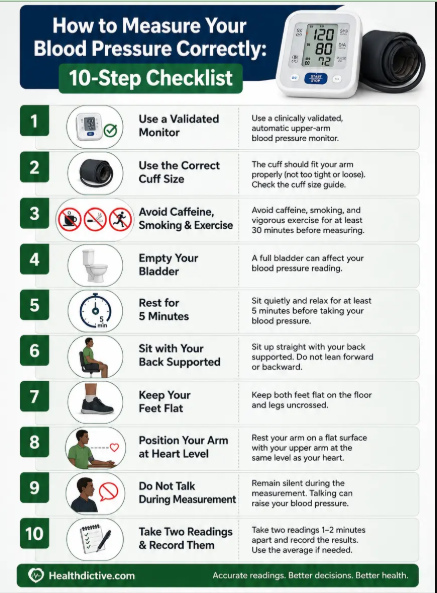
1. Use a Validated Blood Pressure Monitor
The first step in accurate blood pressure measurement is using equipment that can produce reliable results.
For home monitoring, an automatic upper-arm blood pressure monitor is generally preferred over wrist or finger devices. The American Heart Association recommends an automatic, cuff-style upper-arm monitor for home use and advises choosing a device that has been validated for accuracy.
The World Health Organization also emphasizes the importance of accurate, validated automated blood pressure measuring devices, particularly because inaccurate equipment can undermine hypertension detection and management.
What should you look for?
When buying a BP machine:
- Choose an upper-arm model where possible.
- Check that the device has been independently validated.
- Make sure the cuff fits your arm.
- Follow the manufacturer’s instructions.
- Replace batteries when necessary.
- Keep the device clean and in good condition.
- Take the monitor to a healthcare appointment periodically so its readings can be compared with the clinic equipment.
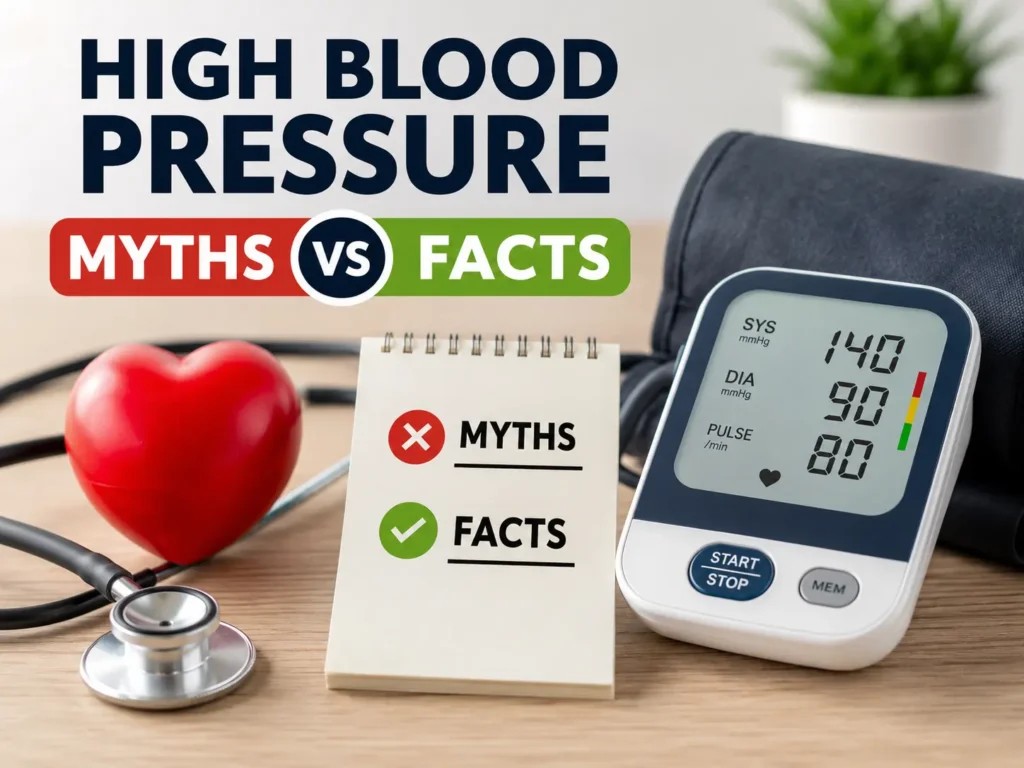
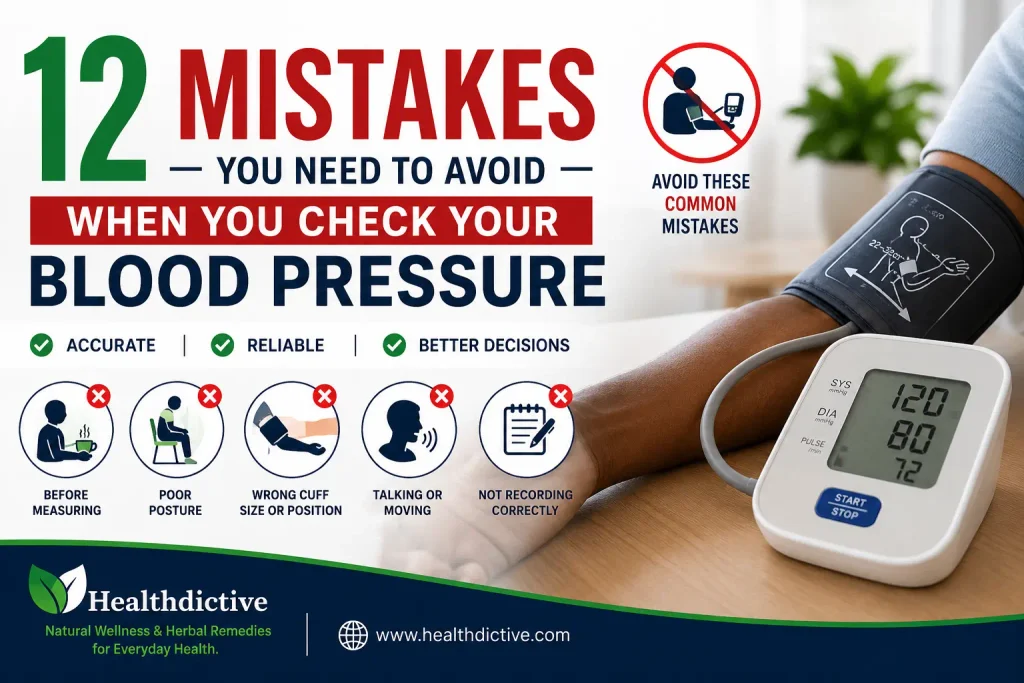
The AHA recommends bringing your home monitor to a healthcare appointment so that a professional can check whether you are using it correctly and whether its readings are comparable with the office equipment.
Expert Tip
Do not assume that an expensive BP machine is automatically accurate.
Validation matters more than appearance, brand popularity or the number of extra features.
2. Use the Correct Blood Pressure Cuff Size
This is one of the most overlooked causes of inaccurate blood pressure measurement.
The cuff must fit the person’s upper arm.
A cuff that is too small can produce an inaccurately high reading. A cuff that is too large can also distort the result.
Modern evidence shows that cuff size can produce clinically meaningful differences in automated BP readings. In the Cuff(SZ) randomized crossover trial, using an inappropriate cuff produced substantial measurement errors, particularly in people requiring large or extra-large cuffs.
How do you choose the right cuff?
Measure the circumference of the upper arm, usually around the midpoint between the shoulder and elbow.
Then use the cuff manufacturer’s recommended arm-circumference range.
Do not simply use the “standard adult” cuff for everyone.
Why this matters in Nigeria
A clinic, pharmacy or home may have only one commonly used cuff size.
That is not ideal.
Children, very slim adults, muscular adults and people with larger arms may require different cuff sizes.
Healthcare facilities should therefore have appropriate cuff sizes available rather than assuming one cuff fits everyone.
Remember
Correct cuff size + correct positioning + correct technique = more reliable measurement.
3. Avoid Caffeine, Smoking and Exercise Before Measuring
Your blood pressure is not a fixed number.
It responds to what you are doing.
For a more reliable resting measurement, avoid:
- Exercise
- Smoking or tobacco
- Caffeinated drinks
for about 30 minutes before measurement.
The AHA and ACC/AHA measurement recommendations specifically advise avoiding caffeine, exercise and smoking for at least 30 minutes before measuring BP.
What counts as caffeine?
Depending on your habits, this may include:
- Coffee
- Energy drinks
- Some teas
- Cola-type soft drinks
- Caffeinated pre-workout products
Nigerian practical example
Suppose you:
- Walk quickly from the bus stop.
- Climb two flights of stairs.
- Enter a pharmacy.
- Drink a caffeinated beverage.
- Immediately check your BP.
That reading may not represent your resting BP.
Instead, sit quietly and allow your body to settle before measuring.
What about food?
Guidelines vary somewhat in exactly how food intake should be handled. A practical approach is to avoid measuring immediately after a meal and follow the instructions given by your healthcare professional or monitor manufacturer.
The CDC also recommends avoiding eating or drinking for 30 minutes before measurement.
4. Empty Your Bladder and Rest Quietly
A full bladder can affect blood pressure measurement.
Before checking your BP:
- Use the toilet if you need to.
- Sit in a quiet place.
- Rest for at least five minutes.
- Avoid conversation.
- Avoid using your phone during the rest period.
The CDC, AHA and other major guidelines recommend a quiet rest period before measurement.
Why five minutes?
The purpose is to allow your body to move toward a resting state.
If you measure immediately after walking, rushing, climbing stairs or becoming stressed, the reading may reflect that activity rather than your resting BP.
A simple rule
Don’t arrive breathless and immediately measure your BP.
- Sit down.
- Relax.
- Wait.
- Then measure.
5. Sit in the Correct Position
Your posture matters.
For a standard seated measurement:
- Sit in a chair.
- Support your back.
- Keep both feet flat on the floor.
- Keep your legs uncrossed.
- Keep your body relaxed.
- Avoid leaning forward.
- Do not sit on the edge of a chair if it leaves your back unsupported.
The CDC specifically recommends a supported back, feet flat on the ground and legs uncrossed.
Why not cross your legs?
Leg crossing can change blood pressure readings.
Older AHA research found that crossing the legs can increase systolic BP, while lack of back support can also raise readings.
The effect may not be dramatic in every person, but when you are trying to detect relatively small changes, consistency matters.
Do not measure while:
- Standing, unless specifically instructed
- Walking
- Sitting on a toilet
- Sitting on a bed without support
- Talking to someone
- Moving around
For routine resting BP, a stable seated position is preferred.
6. Position Your Arm at Heart Level
This is one of the most important practical tips.
- Place the arm being measured on a table or other firm support.
- The middle of the cuff should be approximately at heart level.
- Your arm should be relaxed.
- Do not allow it to hang beside your body.
- Do not hold it up yourself.
- Do not rest it on your lap if that leaves the cuff well below heart level.
- The AHA recommends supporting the arm and positioning the cuff around heart level.
Why does arm height matter?
Blood pressure is affected by gravity and the vertical distance between the cuff and heart.
When the arm is significantly below heart level, the reading may be higher.
When the arm is above heart level, the reading may be lower.
Practical example
If you are measuring your BP at home:
Sit at a table → place your arm on the table → relax your shoulder → keep the cuff approximately level with your heart.
This is much better than holding your arm in the air.
7. Put the Cuff on Bare Skin
- Do not place the cuff over clothing.
- Remove clothing from the upper arm before applying the cuff.
- The cuff should sit snugly against the skin without being unnecessarily tight.
The CDC recommends placing the cuff against bare skin rather than over clothing.
What about rolling up your sleeve?
Avoid tightly rolling a sleeve around the upper arm because it can create a tourniquet-like effect.
Instead, use short sleeves or remove the arm from the sleeve if practical.
Where should the cuff sit?
Follow the monitor manufacturer’s instructions.
For many upper-arm devices, the lower edge of the cuff sits just above the bend of the elbow.
The cuff’s artery marker, if present, should be positioned as directed by the manufacturer.
8. Do Not Talk or Move During the Reading
This sounds simple.
Yet it is one of the most common mistakes.
Do not:
- Talk
- Laugh
- Answer questions
- Text
- Make phone calls
- Watch something that makes you excited
- Move your arm
- Shake your legs
- Tighten your muscles
during the measurement.
The CDC specifically recommends not talking while BP is being measured.
What about talking to the pharmacist?
If you are having your BP checked in a Nigerian pharmacy, it is tempting to continue the conversation.
Instead:
finish the conversation → sit quietly → measure → discuss the result afterward.
This small change can improve measurement consistency.
9. Take Two or More Readings
A single reading is a snapshot.
Your blood pressure can change from minute to minute.
That is why repeated measurements are useful.
The AHA recommends taking two readings about one minute apart and recording the results.
For example:
| Reading | BP |
|---|---|
| First | 146/91 mmHg |
| Second | 140/88 mmHg |
The two readings are not identical, and that is normal.
Rather than becoming alarmed by one number, record both and follow the monitoring plan recommended by your healthcare professional.
For home monitoring
NICE recommends, when confirming hypertension with home monitoring, taking two consecutive measurements at least one minute apart, twice daily, ideally morning and evening, for at least four days and preferably seven days.
This is different from simply checking your BP once when you feel worried.
Important distinction
Taking two readings during one session is not the same as diagnosing hypertension from two readings.
Diagnosis requires appropriate clinical assessment and, depending on the situation, repeated home or ambulatory monitoring.
10. Record Your Blood Pressure Consistently
A BP number without context can be difficult to interpret.
Record:
- Date
- Time
- Systolic BP
- Diastolic BP
- Pulse, if displayed
- Which arm was used
- Any unusual circumstances
- Relevant medication timing if your healthcare professional asks you to record it
Example BP log
| Date | Time | BP | Pulse | Notes |
|---|---|---|---|---|
| Monday | 7:30 am | 138/86 | 72 | Before breakfast |
| Monday | 7:31 am | 134/84 | 70 | Resting |
| Monday | 7:30 pm | 141/88 | 75 | Rested 5 min |
| Tuesday | 7:30 am | 135/83 | 69 | Normal |
A pattern is more useful than one isolated number.
Home monitoring can also help healthcare professionals understand whether treatment is working. Evidence reviews have found that self-measured BP monitoring can produce modest improvements in BP control, especially when combined with additional support.
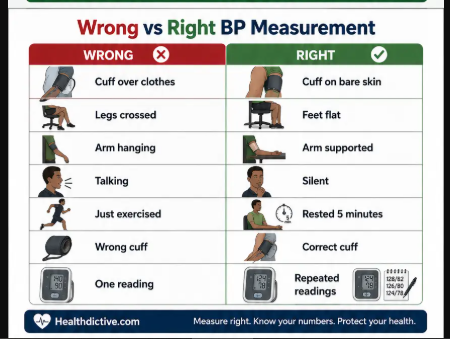
How to Measure Blood Pressure Correctly at Home
Here is the complete home procedure.
Before measurement
30 minutes beforehand
Avoid:
- Smoking
- Exercise
- Caffeine
Avoid measuring immediately after rushing around.
Immediately beforehand
- Empty your bladder.
- Find a quiet place.
- Sit in a chair.
- Rest for at least five minutes.
During measurement
- Sit with your back supported.
- Keep both feet flat on the floor.
- Keep your legs uncrossed.
- Rest your arm on a table.
- Keep your arm approximately at heart level.
- Put the cuff directly on bare skin.
- Use the correct cuff size.
- Stay quiet and still.
- Start the monitor.
- Wait for the result.
- Record it.
- Wait about one minute.
- Take the second reading.
- Record it.
This basic procedure is consistent with recommendations from the CDC, AHA, NICE and major hypertension guidelines.
Common Blood Pressure Measurement Mistakes
Mistake 1: Checking immediately after exercise
If you have just climbed stairs or walked quickly, wait.
Mistake 2: Using the wrong cuff
A standard cuff is not automatically appropriate for every arm.
Mistake 3: Measuring over clothing
Put the cuff on bare skin.
Mistake 4: Letting the arm hang down
Support the arm at heart level.
Mistake 5: Crossing your legs
Keep both feet flat.
Mistake 6: Talking
Stay silent during the reading.
Mistake 7: Taking only one reading
Take a second reading when appropriate.
Mistake 8: Measuring while stressed
Allow yourself time to settle.
Mistake 9: Using an unvalidated monitor
Accuracy begins with the device.
Mistake 10: Changing medication based on one reading
Never independently increase, decrease or stop prescribed BP medicine because of a single home reading.
Why Blood Pressure Readings Can Change
You may measure 150/92 at 8:00 am and later get: 137/84 at night. That does not automatically mean that one machine is faulty.
Blood pressure naturally varies.
Factors that may influence readings include:
- Physical activity
- Stress
- Anxiety
- Pain
- Caffeine
- Smoking
- Body position
- Talking
- Full bladder
- Recent food or drink
- Medication timing
- Poor sleep
- Measurement technique
- Cuff size
- Device differences
A systematic review found significant effects from many potential sources of measurement inaccuracy, although the direction and size of the effect varied between factors and studies.
Therefore, do not focus excessively on tiny differences between individual readings.
Focus on proper technique and trends over time.
Home BP Monitoring vs Clinic Measurement
Both are useful, but they answer slightly different questions.
| Feature | Clinic BP | Home BP | Ambulatory BP |
|---|---|---|---|
| Location | Healthcare facility | Home | Normal daily environment |
| Multiple readings | Possible | Yes | Yes |
| White-coat effect | More likely | Less likely | Can identify |
| Night-time readings | Usually no | Usually no | Yes |
| Convenience | Moderate | High | Moderate |
| Requires equipment | Clinic equipment | Home monitor | ABPM device |
| Useful for monitoring | Yes | Yes | Yes |
| Useful for confirming diagnosis | Sometimes | Yes, when properly performed | Particularly useful |
Research comparing clinic and home measurement with ambulatory monitoring shows that neither clinic nor home BP is perfect as a standalone diagnostic test.
NICE states that ambulatory BP monitoring is the most accurate method for confirming hypertension when appropriate, with home monitoring used when ABPM is unsuitable or unavailable.
White-Coat and Masked Hypertension
What is white-coat hypertension?
Some people have higher BP in a healthcare setting than they do outside the clinic.
This is commonly called white-coat hypertension.
It can occur because a person becomes anxious during medical visits.
What is masked hypertension?
The opposite can happen.
A person’s clinic BP may look normal, while their BP outside the clinic is higher.
This is called masked hypertension.
Home and ambulatory monitoring can help identify patterns that a single clinic reading may miss.
This is one reason accurate home measurement is valuable.
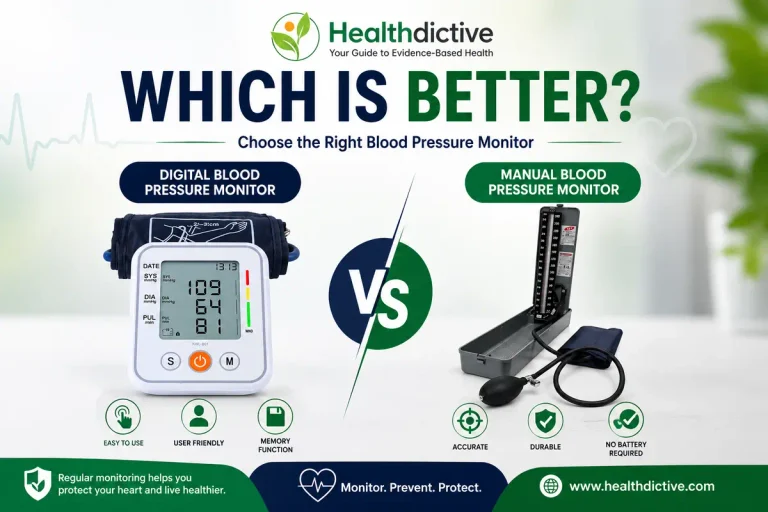
What About Manual vs Digital Blood Pressure Monitors?
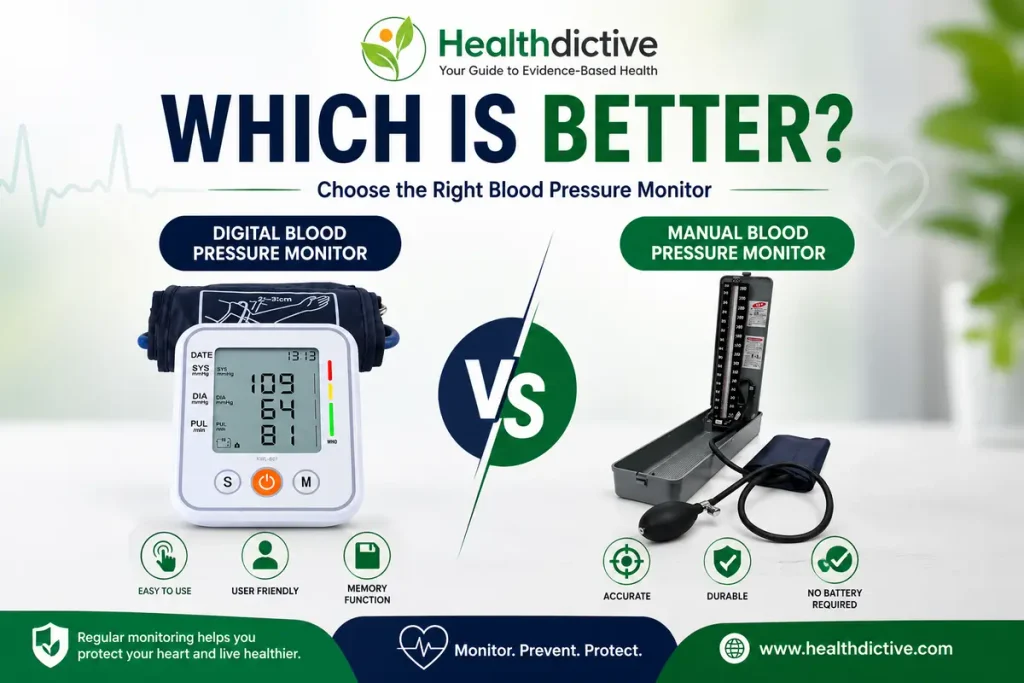
Manual and digital monitors can both be useful.
However, they are not equally convenient for everyone.
A manual sphygmomanometer requires:
- Correct cuff selection
- Inflation technique
- Stethoscope use
- Knowledge of Korotkoff sounds
- Proper deflation technique
- Training and experience
Digital monitors are easier for most people to use at home.
Healthdictive’s existing guide provides a detailed comparison of manual and digital blood pressure monitors.
For most home users, the practical priority should be: validated upper-arm device + correct cuff + correct technique.
Blood Pressure Measurement in Nigeria
Accurate BP measurement is particularly important in Nigeria because blood pressure checks occur in many different settings.
You may have your BP measured:
- In a teaching hospital
- At a general hospital
- In a primary healthcare centre
- At a community pharmacy
- At a workplace
- At a health outreach programme
- At home
- During a church or community screening
The setting should not determine whether good technique is used.
If you are checking BP at a Nigerian pharmacy
Don’t be afraid to ask:
“Can I sit quietly for five minutes before taking the reading?”
You can also ask:
“Does this cuff fit my arm?”
And:
“Can I take a second reading?”
These are reasonable questions.
If you just arrived from outside
For example, if you:
- Walked under the hot sun
- Climbed stairs
- Rushed to catch a bus
- Carried heavy bags
- Were upset or anxious
allow yourself time to settle before measurement.
The goal is not to get the lowest possible number.
The goal is to obtain a representative resting measurement.
What About Nigerian Foods, Drinks and Herbs?
This article is about measuring blood pressure, not treating hypertension with food or herbs.
Still, readers often ask whether Nigerian foods or herbal drinks can affect BP.
The important point is that you should not assume that a drink or herb is irrelevant simply because it is “natural.”
Examples include:
- Zobo
- Ginger drinks
- Garlic preparations
- Moringa products
- Herbal mixtures
- Energy drinks
- Coffee
- Alcoholic beverages
Some foods and herbs may affect BP or interact with medicines.
Healthdictive’s articles on Nigerian herbs for high blood pressure discuss these issues in greater detail, including the difference between promising laboratory findings and stronger human clinical evidence.
If you take antihypertensive medication and regularly use herbal products, tell your doctor or pharmacist.
Do not stop prescribed medicine simply because a herbal preparation appears to lower your BP.
Myth vs Fact
| Myth | Fact |
|---|---|
| One high reading means I have hypertension. | One reading is not usually enough to establish a diagnosis. |
| A digital machine is always accurate. | Accuracy depends on device validation, cuff size and technique. |
| A larger cuff is always better. | The cuff should match the person’s arm circumference. |
| I can check BP immediately after exercise. | Rest first for a more representative resting measurement. |
| Talking doesn’t matter. | Talking can affect the measurement. |
| I should cross my legs because it is more comfortable. | Keep both feet flat and legs uncrossed. |
| I can hold my arm myself. | Supporting the arm is preferable. |
| The cuff can go over my shirt. | Place it on bare skin. |
| My BP should be exactly the same every time. | BP naturally varies. |
| If my BP is normal today, I don’t need monitoring. | People with hypertension should follow their healthcare professional’s monitoring plan. |
| A high reading means I should take an extra dose. | Do not change prescribed medication without medical advice. |
| Wrist monitors are always better because they are easier. | Upper-arm validated monitors are generally preferred for home use. |
Expert Tips for More Reliable Readings
Expert Tip 1: Standardize your routine
If you monitor at home regularly, try to measure at approximately the same times and under similar conditions.
Expert Tip 2: Use the same arm consistently
Your healthcare professional may advise which arm to use.
At an initial assessment, BP may be checked in both arms. If there is a persistent significant difference, discuss it with your healthcare professional.
Expert Tip 3: Bring your monitor to clinic
This allows a healthcare professional to check your technique and compare the device with clinic equipment.
Expert Tip 4: Don’t chase a number
Do not repeatedly measure your BP every few minutes simply because you dislike the first result.
Repeated checking can increase anxiety and make interpretation more difficult.
Follow a structured monitoring plan.
Expert Tip 5: Look for trends
A week of properly performed readings can tell your healthcare professional much more than a random reading taken under stressful conditions.
Practical Blood Pressure Measurement Checklist
Before pressing the START button, ask:
Environment
☐ Is the room reasonably quiet?
☐ Have I rested for at least five minutes?
Preparation
☐ Have I avoided exercise for about 30 minutes?
☐ Have I avoided smoking?
☐ Have I avoided caffeine?
☐ Is my bladder empty?
Position
☐ Is my back supported?
☐ Are both feet flat on the floor?
☐ Are my legs uncrossed?
☐ Is my arm supported?
☐ Is my arm approximately at heart level?
Cuff
☐ Is the cuff the correct size?
☐ Is it on bare skin?
☐ Is it positioned correctly?
Measurement
☐ Am I quiet?
☐ Am I still?
☐ Did I take a second reading?
☐ Did I record the result?
If you can answer “yes” to these questions, your measurement technique is likely to be much better than simply putting on a cuff and pressing a button.
Action Plan: Start Measuring BP More Accurately Today
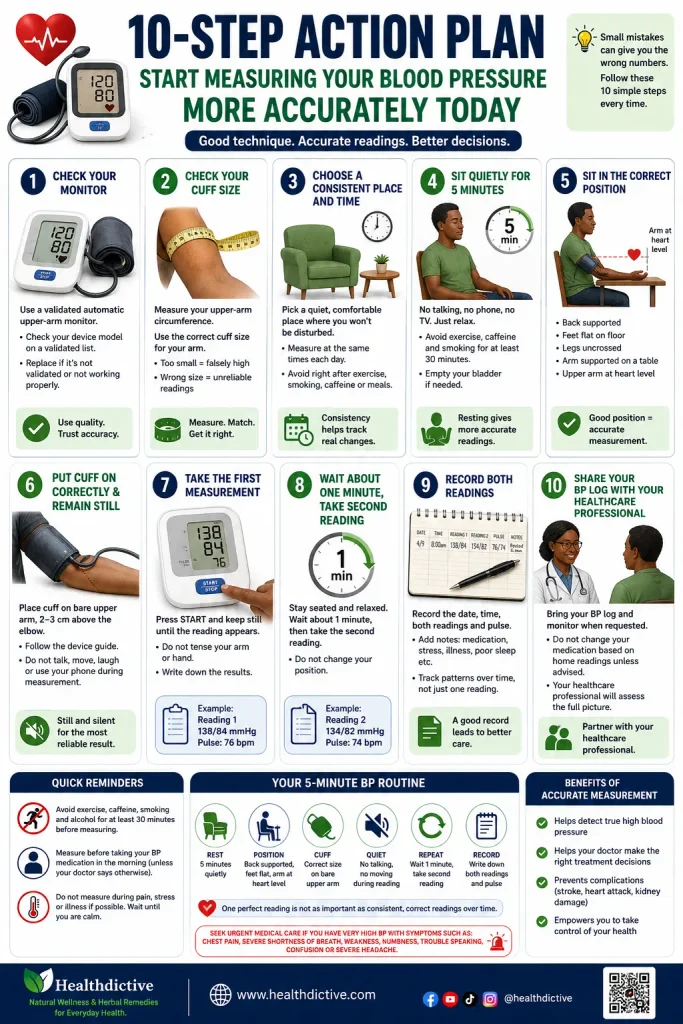
Step 1: Check that your monitor is suitable
Use a validated automatic upper-arm blood pressure monitor whenever possible. Wrist and finger monitors can be more difficult to position correctly and may be less reliable.
Before relying on a monitor, check whether the specific device has been independently validated for accuracy. Do not assume that an expensive monitor is automatically accurate.
Action: Check the model number of your monitor against a recognized validated-device list, and replace an unreliable or damaged device.
Step 2: Measure your upper-arm circumference and choose the correct cuff
Measure your upper-arm circumference and make sure your cuff is appropriate. The cuff must fit your arm properly. A cuff that is too small can produce a falsely high reading, while an incorrectly sized cuff can make your results unreliable.
Measure around the middle of your upper arm and compare the measurement with the cuff manufacturer’s recommended range.
Action: Do not simply use the cuff that came with the monitor if it does not fit your arm correctly. Obtain the appropriate cuff size.
Step 3: Choose a consistent place and time for measurement
Choose a consistent place for measurement. Try to measure your blood pressure in a quiet, comfortable place where you can sit undisturbed.
If you are monitoring your blood pressure regularly, measuring at approximately the same times each day can make your readings easier to compare.
Avoid measuring immediately after exercise, smoking, consuming caffeine or other stimulants, or rushing around.
Action: Choose a regular location and routine—for example, before breakfast and before taking your morning medication if that is how your healthcare professional has instructed you.
Step 4: Prepare before you measure
For about 30 minutes before measurement, avoid exercise, smoking and caffeine. Empty your bladder if necessary.
When you are ready, sit quietly for at least 5 minutes before starting the measurement.
Do not measure immediately after climbing stairs, walking quickly, arguing, or performing another activity that may temporarily raise your blood pressure.
Action: Give your body time to settle before pressing the START button.
Step 5: Sit in the correct position
Your position matters.
Sit in a chair with:
- Your back supported
- Your feet flat on the floor
- Your legs uncrossed
- Your shoulders relaxed
- Your arm supported on a table or other surface
- Your upper arm positioned approximately at heart level
Do not measure while standing, walking, or sitting unsupported unless specifically instructed to do so.
Action: Set up your chair and table before measuring so that you can maintain the correct position throughout the reading.
Step 6: Put the cuff on correctly and remain still
Take the first measurement without talking. Place the cuff on your bare upper arm, not over clothing. Follow the monitor manufacturer’s instructions regarding cuff placement.
Keep the tubing and cuff positioned correctly, and avoid tightening the cuff manually beyond the manufacturer’s instructions.
Once the measurement begins, do not talk, move, laugh, text, or use your phone.
Even conversation can affect the reading.
Action: Get comfortable, start the monitor and remain completely quiet and still until the measurement is finished.
Step 7: Take the first measurement
Start the monitor while maintaining the correct position.
Keep your arm supported and relaxed. Do not tense your hand or arm, and do not watch the monitor anxiously while it is measuring.
Wait until the device has completely finished and displays the result.
Action: Write down the systolic pressure, diastolic pressure and pulse rate if displayed.
For example:
Reading 1: 138/84 mmHg — Pulse: 76 bpm
Step 8: Wait about one minute and take a second reading
Do not immediately repeat the measurement.
Remain seated and relaxed for about one minute, then take a second reading using the same position and technique.
It is normal for two readings to differ somewhat.
Action: Take the second reading without changing your position or starting another activity.
For example:
Reading 2: 134/82 mmHg — Pulse: 74 bpm
Step 9: Record both readings
Do not rely on memory.
Record the date, time, systolic pressure, diastolic pressure and pulse. If relevant, also record anything that could help explain an unusual reading—for example, stress, illness, missed medication, or recent activity.
A simple log might look like this:
| Date | Time | Reading 1 | Reading 2 | Pulse | Notes |
| 4 Sept | 8:00 am | 138/84 | 134/82 | 76/74 | Rested 5 min |
Keeping a consistent record allows you and your healthcare professional to look at the pattern over time, rather than focusing on one isolated reading.Action: Keep your BP log on paper, in a notebook, on your phone, or in a suitable blood-pressure app.
Step 10: Share your BP record with your healthcare professional
Share your BP log with your healthcare professional when requested. Bring your blood pressure log to your doctor, pharmacist or other qualified healthcare professional when requested.
Do not change, stop or increase blood-pressure medication based solely on home readings unless your healthcare professional has given you a specific plan for doing so.
Your healthcare professional can assess your readings alongside your symptoms, medications, medical history and other risk factors.
Action: Take your monitor and BP log to a healthcare appointment if requested. Your healthcare professional can also check whether you are using the monitor and cuff correctly.
This simple routine can make home BP monitoring much more useful.
Your 5-Minute Blood Pressure Routine
Before pressing START, remember:
REST → POSITION → CUFF → QUIET → REPEAT → RECORD
- Rest: Sit quietly for at least 5 minutes.
- Position: Back supported, feet flat, legs uncrossed and arm supported at heart level.
- Cuff: Use the correct-sized cuff on your bare upper arm.
- Quiet: Do not talk or move during the measurement.
- Repeat: Wait about 1 minute and take a second reading.
- Record: Write down both readings and the pulse if available.
Safety Considerations
Accurate measurement is important, but measurement is not treatment.
Do not:
- Stop prescribed BP medication because a reading improves.
- Double your medication because of one high reading.
- Replace medical treatment with an unproven herbal remedy.
- Diagnose yourself from one isolated measurement.
- Ignore repeated high readings.
- Ignore symptoms because a previous BP reading was normal.
If you are pregnant, have kidney disease, diabetes, heart disease or another significant medical condition, ask your healthcare professional how often you should monitor your BP and what readings require action.
One final rule
Do not panic over one unusual reading. Blood pressure naturally varies throughout the day. What matters is obtaining measurements correctly and looking at the pattern over time.
However, if your blood pressure is very high and you have symptoms such as chest pain, severe shortness of breath, weakness or numbness, difficulty speaking, confusion, or a severe unusual headache, seek urgent medical attention rather than repeatedly checking your blood pressure at home.
When Should You See a Healthcare Professional?
Arrange a medical assessment if your BP readings are repeatedly above the range recommended by your healthcare professional.
You should also discuss:
- Repeatedly high home readings
- Repeatedly low readings with symptoms
- Large differences between arms
- Dizziness or fainting
- Problems using your monitor
- Uncertainty about cuff size
- Possible medication side effects
- BP that remains high despite treatment
What if the reading is 180/120 mmHg or higher?
Do not panic, but do not ignore it.
Sit quietly and repeat the measurement after at least one minute.
If it remains very high, seek urgent medical advice.
If very high BP occurs together with symptoms such as:
- Chest pain
- Shortness of breath
- Weakness or numbness
- Difficulty speaking
- Vision changes
- Severe or unusual symptoms
- Confusion
seek emergency medical care immediately.
The AHA identifies BP above 180/120 mmHg with concerning symptoms as a medical emergency.
In Nigeria, this means contacting an appropriate emergency service or going to the nearest hospital capable of providing urgent medical assessment.
Frequently Asked Questions
1. What is the correct way to measure blood pressure?
Sit quietly for at least five minutes, keep your back supported and feet flat, use the correct cuff on bare skin, support your arm at heart level, remain quiet and still, and take repeated readings.
2. How long should I rest before checking my BP?
Rest quietly for at least five minutes before measurement.
3. Should my arm be at heart level?
Yes. Support the arm so the cuff is approximately at heart level.
4. Should I cross my legs when measuring BP?
No. Keep both feet flat on the floor and your legs uncrossed.
5. Can talking affect my BP reading?
Yes. Talking during measurement can make the reading less representative of your resting BP.
6. Can I measure BP over my clothes?
It is better to place the cuff directly on bare skin.
7. How tight should the cuff be?
It should fit snugly according to the manufacturer’s instructions, but the most important issue is using the correct cuff size for your arm.
8. How do I know which cuff size I need?
Measure your upper-arm circumference and match it with the cuff manufacturer’s stated range.
9. Is an upper-arm monitor better than a wrist monitor?
For most home users, a validated upper-arm monitor is preferred because wrist and finger devices can be more difficult to position correctly and may provide less reliable readings.
10. How many times should I measure my BP?
For routine home monitoring, take two readings about one minute apart unless your healthcare professional gives you a different protocol.
11. Why should I take two readings?
Blood pressure varies naturally. Repeated readings provide more information than a single measurement.
12. Can coffee affect my BP reading?
Caffeine can temporarily affect BP. Avoid caffeinated drinks for about 30 minutes before measurement when possible.
13. Can exercise affect BP?
Yes. Exercise temporarily changes BP. Wait before measuring resting BP.
14. Why is my BP higher at the hospital?
Some people experience white-coat hypertension, where BP is higher in a clinical setting.
15. Can my BP be normal at the clinic but high at home?
Yes. This can occur with masked hypertension.
16. Can one high reading diagnose hypertension?
Usually, no. Diagnosis requires appropriate clinical assessment and often repeated measurements or out-of-office monitoring.
17. What should I do if my BP is 180/120?
Repeat the measurement after resting briefly. If it remains at that level, seek urgent medical advice. If it is accompanied by concerning symptoms such as chest pain, breathing difficulty, weakness or neurological symptoms, seek emergency care immediately.
18. Should I stop my medicine if my home BP becomes normal?
No. Do not stop or change prescribed BP medication without speaking with your healthcare professional.
19. Is home BP monitoring useful?
Yes. Home monitoring can help clinicians understand BP patterns and monitor treatment, provided the equipment and technique are appropriate.
20. What is the biggest mistake people make when measuring BP?
There is no single mistake for everyone, but common problems include incorrect cuff size, poor posture, insufficient rest, unsupported arms, talking and using an unvalidated device.
Conclusion
Accurate blood pressure measurement is not complicated, but it requires consistency.
The most important steps are simple:
- Use a validated upper-arm monitor.
- Choose the correct cuff size.
- Avoid caffeine, smoking and exercise before measuring.
- Empty your bladder and rest for at least five minutes.
- Sit with your back supported and feet flat.
- Keep your arm supported at heart level.
- Put the cuff directly on bare skin.
- Stay quiet and still.
- Take repeated readings.
- Record your results consistently.
These steps matter because an inaccurate reading can create confusion. A falsely high reading may cause unnecessary worry or inappropriate treatment decisions, while a falsely low reading could provide false reassurance.
Blood pressure should therefore be measured carefully—not simply quickly.
For Nigerians, this is particularly practical. Whether your BP is being checked at a hospital, pharmacy, workplace, health screening event or at home, good technique should remain the same.
And remember: a blood pressure monitor is a tool, not a diagnosis.
If your readings are repeatedly high, unexpectedly low, or associated with concerning symptoms, speak with a qualified healthcare professional.
Your next step
If you already have a BP monitor at home, use the checklist in this article the next time you measure your blood pressure.
Then ask yourself:
“Did I measure my blood pressure—or did I simply get a number?”
That difference matters.
Stay informed with Healthdictive
For more evidence-based information on blood pressure, heart health, Nigerian herbs and healthy living, explore the Healthdictive blood-pressure content cluster.
You can also subscribe to the Healthdictive newsletter for practical health information and new evidence-based guides.